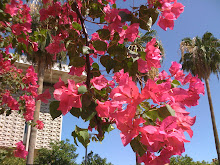
There is a road I traverse every day, along with many hundreds of other people going about their day-to-day business. Along that road are patches of land here and there, still in their natural state, without the typical installments of houses, commercial buildings, or tidy little rows of shrubs dotting cedar bark mulch. There is one patch of wildness in particular that caught my eye, recently.
Fruit trees are in bloom right now, so those trees with blossoms stand out rather vividly against others wearing fresh spring green or deep evergreen foliage. This is how I noticed that, among the grove of trees on this particular piece of land, there were several in bloom. The grove was not neat and orderly, rather, it was slowly being reclaimed by the surrounding thickets of vegetation. I wondered if the fruit trees had been planted by one of the Norwegian settlers during the last century, at the time that much of the old growth forest was cut down and floated south to build Seattle, leaving fields where cows would graze in their place. Farms and fruit trees, people and progress. But now, this orchard has been neglected, forgotten. Unlike the old forests and so many other young trees nearby, these have not yet been cut down, their roots pulled up and burned, the ground dug up and covered with pavement or houses, erasing all memory of their presence. Instead, the forgotten orchard is being accepted back into the wildness that still lives, that is now surrounding it and softening the man-made order that once tamed the forest and pushed its beautiful savagery away.
As I pass by this forgotten orchard, I wish that I were a child again, free to explore unhindered by knowledge of private property boundaries. If I were small, walking barefoot, and uncaring of the reality that home was several miles away, I would leave that road traveled by anxious commuters and find an opening in the hedge.
Hidden by briar bushes and trees several times my height, I would find the footpaths used by the deer and nocturnal creatures, and follow them through the forgotten orchard. The sound of automobile traffic would fade, the calls of robins, blackbirds, finches, mourning doves, and flickers would emerge, and the lulling, gentle sound of breezes rustling through leaves would wipe away the demands of time. Finding a sun-dappled patch of grass, untouched by mowers for many seasons, I would lie in that nest and gaze up through the blossoming branches of the fruit trees. Come summertime, I would find the best trees for climbing, and discover what fruit ripened on the branches. I would find the best places for hiding from intruders, and for sitting to watch the wild things. If I were to lie on my stomach, knees bent and bare feet in the air, chin resting on folded arms, still and silent, I might see the fairies come out to play. Some with wings like butterflies, bold and colorful, others with delicately veined and glinting wings like dragonflies, they would emerge from their secret hideaways in the forgotten orchard. Sitting on toadstools to tell stories, sipping nectar from flowers, dancing in the soft green moss, or singing Olden Faerie songs, they would exult in this place where my imagination brings them to life, as it drinks its fill from the magic of a beautiful, blessedly forgotten grove.
Sunday, April 22, 2007
The forgotten orchard

Friday, April 20, 2007
Stargazing
The sky is clear tonight, and I was able to see the stars as I drove home and walked out to the mailbox. Venus shines brightly near the pathway the moon travels, and other constellations stand out against the depth of space. A few nights ago I saw the moon as it was rising, and although only a sliver was illuminated, the rest of it was also faintly visible. The orb of it seemed to be rising out of the sea, only to be plunged back below its surface in a matter of hours.
I witness the passage of Venus, and as my mind wanders, I realize that one of these stars could be dying in a brilliant supernova right now, but we on earth will not see it for light years...how many generations into the future? This starry night, with frogs singing from their secret places in watery drainage ditches, brings a memory to mind. It is a memory not specifically of one time, but of many starry summer nights through the years. I remember something that has become a sort of tradition. On warm summer nights in Oregon, it would be very hot and stuffy inside the house still, and so I would sit outside on the deck before going to bed. I would be barefoot, the deck would be rough beneath my feet, and the uneven boards would creak a bit. I would pull up one of the dirty old patio chairs, brush the fallen madrone bark and leaves off of it, and sit looking up at the sky. Often, one of the dogs would be there too, laying at my feet or leaning against my leg as I slowly run my hand over its soft ears and fur. Breathing in, I would smell the familiar dry scents of summer: the madrone tree in the yard shedding its leaves, the faint smell of a barbecue, the breezes coming from the direction of the river. Sometimes my dad would join me outside, contentedly smoking a cigar in peaceful silence, while we looked up at the stars. If I waited and looked long enough, I might see a shooting star, or at least pick out a satellite making its way steadily across the horizon. The wind would stir the dilapidated wind chimes, and the song of crickets would match the flickering of the stars. Bats would come out, fluttering silently overhead, their shadowy acrobatics unnoticed by most of the sleepy world.
I had some of my best conversations with Dad out there, talking about the past, the future, the present, music, and ideas until his cigar had burned low (and I had tapped the ash off at least once), the breezes had cooled me, and the mosquitos had become alerted to my presence. I would pat the dog and stand up, old boards groaning as the deck adjusted itself, and take one last deep inhalation of the starry night before going in to bed.
Wednesday, April 11, 2007
Wishing wells
I have spent quite a bit of time observing other people's romantic relationships, learning vicariously from their mistakes, and spinning philosophical thoughts like this around and around. This is one observation of many:
Some folks approach their relationship as if the other person were a wishing well, and they cast their dreams, opinions, desires, ambitions, and destinies into that person and stand looking over the edge, waiting for their wishes to come true. But those things aren't just pennies or fish food that get cast into the wishing well, they are pieces of a person's heart, future, body, and spirit. If the wishes don't come true, those pieces have to be regrown, they can't be grafted back on...one must start over. They were doomed to failure if they wanted to fulfill Self at the expense of the Other, or even if they simply neglected to give up some wishes in order to receive the valuable things the other person could offer.
Sometimes this trial-and-error experience may be the only way to learn who and what is NOT right, so that one can recognize what IS right when it comes along. Which makes me wonder: when it is my turn, will I step up to look into the well of another person and only see my own reflection, waiting for me to throw my wishes in, or will I have the strength of spirit to look deep enough for long enough to find what is truly below the surface? Will I search for hidden treasure and find it, in spite of the weeds, the skeletons, and the pieces of other people that have been left behind? And if I find only skeletons, will I have been smart enough to bring a lifeline to pull myself back up and out of that well? And while I'm on a roll with the rhetorical questions and metaphors, what would someone find if they came to me not seeking a wishing well, but a well from which they could drink in order to stay alive? Would they keep coming back to me for more, because there is enough substance and depth that there will always be enough encouragement, ideas, compassion, prayers, and conversations to nourish the soul? Can I share the Source of my wellspring in such a way that, whoever draws something out of me will get a helping of the Source, too? Finally, can I be humble enough to clean my own well regularly, so that my analysis of self and others is filtered fairly and with good judgement?
Tuesday, April 10, 2007
Sky at my feet
An ordinary parking lot
black and glistening from recent rain,
littered with gravel, scraps,
and marked by many muddy footprints,
suddenly holds portals
to the great beyond.
Magnificent puddles
spreading like small lakes
across the dirty asphalt
mirror the sky above,
and I am falling up into their depths.
Treading carefully
I navigate like a bird
across the sky lying near my feet,
for I hope to not disturb the water
lest I step through the portal,
and shatter the sky into a million pieces.
Enchanted by Sky
Why am I so enchanted by the sky?
I am enchanted
by its living poetry, poetry in motion;
recreated, repeated, refreshed,
history replayed, yet moving toward the future,
an epic unfolding each minute
as new verses are written,
progressing since time was begun
and this sky was set into motion.
I am enchanted by this poem called Sky;
its words are colors and textures:
blended blues and grays of storm-clouds,
soft purples and pinks of sunsets,
warm brightness of sunrise and late afternoon,
layered hues of rainbows,
bright blue of a vast expanse,
deep black of night adorned by starry gems
in the poem called Sky.
In the poem called Sky
the rhythms are weather and seasons:
winds traveling to unknown destinations,
clouds shifting as if in metamorphosis,
rain drumming its ancient patterns upon the earth,
snow dancing in silent swirls of white,
days folding into the embrace of night,
mornings blossoming again from its depths,
the constellations revolving like an ever-turning wheel,
the moon finding and losing itself in shadow,
planets glistening in and out of sight,
birds floating aloft in these streams of rhythms
in the poem called Sky.
Perhaps only angels
can speak the language of such divine poetry,
or perhaps it is known
only to God.
Nevertheless, this poem called sky
speaks to me,
and I am enchanted.
Friday, April 6, 2007
Impressions and Impressionism
Today is a beautiful, colorful day. The colors are not just the kind that you see, but also the kind that you hear, smell, feel on your skin, and feel in your heart.
The neighbor’s cat keeping me company on the porch is a rich, deep brown, like dark chocolate, thick velvet, and warm shadows.
The tulip tree across the street wears blossoms of living porcelain, pure white touched with mauve, delicate and graceful.
The once-bare branches of trees are bursting with green buds, vibrant life springing forth, while crew-cut lawns sport freckles of dandelions.
The mountains stand out starkly against the clear sky, their crags revealed by the spring thaw. They resemble giant doughnuts or bundt cakes, with snow dripping like icing down their sides and into crevices. Mt. Baker is all angles, reminding me of the blocks of chalk that I used as a gymnast, breaking them apart into snowy chunks, and then grinding them to dust to spread on my hands before beginning an uneven bar routine. These mountains sail in the sky on the horizon, while islands and sailboats fly in the sea.
Yellow is in the tulips and dandelions, daffodils and forsythia, and in the brightness of this sunny day. Orange like muted, living flame grows in one of the shrubs that borders my yard, while purple, magenta, and red bloom in the faces of many flowers.
Best of all is the blue, stretching brightly overhead, streaked with airy clouds, the shadowed blue of distant forested hills, and the silver-faced surface of the water spreading out before me, cheerfully mirroring the sky.
People are like that water, I think, when they reflect the things they surround themselves with, their circumstances, their attitudes and opinions. Some are bright blue only when the sky is blue, but some can call it from a source deep below or beyond the surface, even when gray clouds cover the sky and wind tosses the water into white-capped waves.
Colors are a vital part of such impressions, I think, for they have power to move the mind and the emotions, to wake a sleepy soul from hibernation, to cause me to write such observations and comparisons. If a picture is worth a thousand words, then an experience must be worth millions, if one hopes to capture all the details.
This is where Impressionism -the art form- comes in, and can be valuable, although it depends on the artist. It seems to me that Impressionism does not seek to recreate an exact likeness of the subject it represents, because the artist prefers to give more emphasis to the emotions felt or the interplay of light, shadow, color, mood, or atmosphere than to complete definition. One can still understand what the subject of the art is, because structure and form have not been thrown out the window, those foundations have just been stretched a bit and given an additional dimension. For example, my two favorite such Impressionists (although they did not much like the term and did not apply it to themselves) are Monet, who painted his gardens at Giverny, Parliament buildings at sunset, people on a picnic, and so forth with emphasis on the colors defining the forms, and Debussy, who colored a soundscape with tones, depicting such things as sails with the blending of tonal structures and painting with a piano, pitches running into each other like water-colors to create an atmospheric composition. They were not photographing a subject, but rather remembering it and responding to it “out loud” as it were, by giving something back to the world to share how they had experienced whatever it was.
An impression can be loosely defined (my paraphrase) as an experience that presses into someone and leaves a mark; the thoughts, emotions, and actions resulting from the experience are the “mark,” the impression. Usually these are fleeting, for the moment passes and the mark fades, just as the colors of today will fade into night, and the happiness brought by the sunshine will soon become memory on a cloudy day. But those deep impressions made on each person throughout life, those events and experiences that leave a lasting mark, the kind that cause one to give something back to the world -whether ugly, beautiful, or mediocre- I believe they shape the inner person in ways that will either bend one into twisted sculpture, stamped by the ugliness in the world, or turn one into a collage of colors, a mosaic of beauty, or a sea that reflects blue sky even when the world is gray. Free will and choice have a great deal to do with that shaping process, but that is a topic for another day. These, however, have been my simple impressions for today, which now I share with you.
What impressions have shaped your soul?
Good Friday
Today is Good Friday, the day when we remember the suffering Christ endured and the life He gave, before we celebrate His Resurrection on Easter. So I print here the lyrics to a hymn, one that always reminds me of the eternal significance of that sacrifice.
“How Deep the Father’s Love for Us”
by Stuart Townsend
How deep the Father’s love for us, how vast beyond all measure
that He should give His only son to make a wretch His treasure.
How great the pain of searing loss, the Father turns His face away
as wounds which mar the Chosen One bring many sons to glory.
Behold the Man upon the cross, my sin upon His shoulders
ashamed I hear my mocking voice call out among the scoffers.
It was my sin that held Him there, until it was accomplished
His dying breath has brought me life, I know that it is finished.
I will not boast in anything, no gifts, no power, no wisdom
but I will boast in Jesus Christ, His death and resurrection.
Why should I gain from His reward? I cannot give an answer
but this I know with all my heart: His wounds have paid my ransom.
Monday, April 2, 2007
On the nature of mayonnaise -a comic interlude

Perhaps it is primarily the texture of mayonnaise that grosses me out, that and its vagueness of flavor (for that reason a few members of my family prefer Miracle Whip, which I do not find to be much of an improvement). I find it necessary to keep the stuff in the house for those rare occasions when I make tuna or deviled eggs, for which I tolerate the minimal amount of mayo required. However, on all other occasions I try to avoid it. I was reminded of why, as I tried to ignore the globs of mayonnaise enough to eat the cheeseburger. It saturated the lettuce, squished throughout the bun, and splurted out of the edges; there was just no ignoring it! Annoyed, I discarded the top bun and pathetic lettuce, as they were far beyond the simple remedy of wiping away the excess mayonnaise. Why is this stuff considered so indispensable, and how did we get this way?
I have found that, the more I understand something, the more I appreciate it; so, I decided to find out more about the origins of mayonnaise. I came across this website, which shed a good bit of light on the history of mayo. Apparently, it’s not as recent of an invention as I had thought; it is at least two-hundred years old. According to the “what’s cooking America” website’s history of sauces:
“Most authorities believe the first batch of this mixture of egg yolks, oil and seasonings was whipped up to celebrate the 1756 French capture of Mahon, a city on the Spanish Isle of Minorca, by forces under Louis-Francois-Armad de Vignerot du Plessis, duc de Richelieu (1696-1788). The Duke, or more likely, his personal chef, is credited with inventing mayonnaise, as his chef created a victory feast that was to include a sauce made of cream and eggs. Realizing that there was no cream in the kitchen, the chef substituted olive oil for the cream and a new culinary creation was born. Supposedly the chef named the new sauce "Mahonnaise" in honor of the Duc's victory…”
I suppose I have more of an appreciation now for the longevity of mayonnaise, and a new understanding of its classification (“sauce”, not just “spread”), but I’m afraid that knowledge hasn’t altered the preferences of my taste buds any. So to you mayonnaise lovers out there, more power to you and less mayo for me, thank you very much!